Predicting the Future Climate*
by
J. Ernest "Sunny" Breeding, Jr., PhD Geophysics
What about Predictions?
Climate science is well understood today. Climate scientists know very well what can happen to the Earth in the future, and it depends on whether we reduce greenhouse gases that are now going into the atmosphere or continue to add greenhouse gases at an ever increasing rate. However, knowing what will happen and when it will happen are two different things. Predicting precisely when something will happen, such as when the sea level will rise by 4 feet (1.2 meters), is difficult for several reasons. For one, it will depend upon the rate at which people will allow carbon dioxide or other greenhouse gases to go into the atmosphere in the future, and that is unknown. Another problem is that we have not been through this before. This is the first time that the Earth has experienced human created global warming. It is not like predicting the path of a hurricane where we have experienced many hurricanes before. With each new hurricane the data is used to check and refine hurricane prediction models. The accuracy in predicting hurricane paths has increased greatly through the years. Some might say "but the Earth has experienced global warming before." That is true, and an example of global warming that occurred through natural processes is on Page 4. The difference between that example and what is happening now is huge, and is one of the difference in time scales. Incidents of global warming that occurred in nature usually took place over many thousands and even millions of years. The changes occurred very slowly. This allowed animal and plant life time to adjust. Even so, some life forms went extinct. The global warming that we are experiencing today is happening on a time scale of decades. The changes are too rapid for nature to be able to properly adjust (Hansen, 2009.) That is why it is necessary for man to fix the problem that man created. In making predictions it is now prudent to error on the side of being conservative. The fact that ice on our planet is melting or breaking up faster than had been expected reinforces this conclusion. As more data is analyzed in the coming decades climate scientists will be able to refine their predictions of when things will happen.
How Much Will the Earth Warm in the Future?
It depends upon the greenhouse gases
As stated above, it is difficult to predict the future warming of the Earth because we do not know how much the rate of adding greenhouse gases to the atmosphere will change. The present situation of continually adding more greenhouse gases is not likely to change until enough people are convinced of the severity of the problem and support lowering dangerous emissions. But even if the emissions of greenhouses gasses stopped today much of the carbon dioxide already in the atmosphere will be there for another century or longer. That is one of the big problems.
|
Fig. 6.1. Model predictions of warming due to greenhouse gases. (USGCRP) |

We are particularly interested in projections of greenhouse gases for the next 50 to 100 years. Fig. 6.1 shows observations from 1900 to near the present and the model simulation for comparison with the measurements. The model prediction is in good agreement with the observations. In Fig. 6.1 there are also three different predictions of warming to the year 2100 based on different rates of the addition of greenhouse gases to the atmosphere. The lower emissions scenario shows an increase in the global average surface temperature of about 4 degrees Fahrenheit (2.2 degrees Centigrade) by the end of the century. That is really a significant increase and will result in much damage if allowed to happen. It is also greater than the 3.6 degrees Fahrenheit (2 degrees Centigrade) limit that the Intergovernmental Panel on Climate Change (IPCC) established that we should not exceed. The other two scenarios show increases of about 7 and 8 degrees Fahrenheit (3.9 and 4.4 degrees Centigrade). Those are very large increases, and will most certainly cause very serious problems to life on Earth.
Carbon Dioxide, Methane, and Gases in the Atmosphere
Based on volume the dry atmosphere (air) is made up mostly of nitrogen at 79.09% and oxygen at 20.95%. At much smaller concentrations are argon at 0.93%, carbon dioxide at about 0.04%, and methane at 0.000179%. Other gases exist, but in very small quantities. Water vapor is very variable throughout the planet, but on average is about 1% of air (Wikipedia, Atmosphere of Earth). Water vapor is also a greenhouse gas, and there is a lot more of it than carbon dioxide in the atmosphere. However, water vapor does not absorb infrared radiation as does carbon dioxide. Water vapor becomes important because there is more of it in the atmosphere as the Earth gets Warmer.
With a concentration of only about 0.04032% (403.2 parts per million (ppm)) in the Earth's atmosphere, the trend value in March 2016, Carbon dioxide is clearly a trace gas. Because this concentration is so low some people assume that carbon dioxide cannot be responsible for the current global warming. Nothing could be further from the truth. When the Industrial Revolution started in Britain in about 1760 the atmospheric concentration was about 280 ppm. A statistic that is much more important is that since the Industrial Revolution the concentration of carbon dioxide in the atmosphere has increased by about 44%. Most of this increase has come since the mid-nineteen hundreds. Carbon dioxide in the Earth's atmosphere is very effective at absorbing infrared radiation emitted from the Earth's surface and then re-emitting it. We found this out on Page 5 when we learned about the greenhouse effect. The result is a warming of the Earth, and if there is too large a concentration of greenhouse gases the result is global warming. That is our problem today.
Methane, which is a naturally occurring greenhouse gas, is a major worry. It comes from organic material that decays in the absence of oxygen and is found in soil and on lake and ocean bottoms. It currently is not as important a greenhouse gas as is carbon dioxide. Methane is also shorter-lived than carbon dioxide. Methane lasts a decade compared to more than a century for carbon dioxide. But by comparison a molecule of methane is about twenty to twenty-five times more powerful as a greenhouse gas than a molecule of carbon dioxide, which is a big concern.
Carbon Dioxide Stored in the Oceans
A lot of carbon dioxide is stored in the oceans. As much as one-third of the carbon dioxide going into the atmosphere is currently thought to be absorbed by the oceans. However, since the oceans are getting warmer the amount of carbon dioxide the oceans can take on is decreasing. Further, at some point the oceans can become saturated with carbon dioxide and not absorb any more from the atmosphere. So in the future, it is difficult to predict when, it is likely that a greater percentage of carbon dioxide emissions will end up in the atmosphere, and that is not a good thing as it will add to the global warming (Broecker and Kunzig, 2008.)
Methane Stored on Continental Shelves
There is an enormous amount of methane frozen in the form of methane hydrates. Large quantities are found in the continental shelf regions of the Arctic Ocean and the Gulf of Mexico. Currently the high pressure and the cold temperature of the water where the hydrates are found keep them stable. The fear is that the warming ocean water could be transported by currents and melt the hydrates causing the release of large quantities of methane into the atmosphere. This would greatly increase the global warming of the Earth (Schmidt and Wolfe, 2009.) We could also pass a tipping point, meaning it would be too late for us to stop the process. We need to make sure that this does not happen by reducing the carbon dioxide in the atmosphere.
Carbon Dioxide Stored in Trees
Trees and plants are a natural sink for carbon dioxide as they absorb it and store it. But large forest areas are being destroyed for farming or to build cities. That means less carbon dioxide is being absorbed. Further, since the trees are often burned, are destroyed by insects, or die from droughts they become a source of carbon dioxide into the atmosphere. We need to plant more trees.
Greenhouse Gases Stored in Permafrost
In the Northern Hemisphere about 25 percent of the land is permafrost (Thompson, December 2015). Permafrost contains a lot of stored carbon dioxide and methane that is released into the atmosphere when it thaws raising the concentration of greenhouse gas emissions. Because of this the Earth warms even more, which is not a good thing. The permafrost closest to the surface is the biggest worry because it is most vulnerable to thawing as the air temperature rises. In Alaska it has been estimated that 38 percent of the near-surface land is permafrost. Canada has a large amount of permafrost (Zerehi, April 2016), and much of it is thawing and releasing the carbon dioxide and methane it once stored into the atmosphere. Permafrost is also thawing due to wildfires, which are occurring more frequently due to drought conditions.
There is an abundance of permafrost in North America, Europe, and Asia that can thaw and release enormous amounts of greenhouse gases into the atmosphere further increasing global warming with very undesirable consequences. We simply cannot allow this to happen and must drastically reduce the greenhouse gases emitted into the atmosphere by the burning of fossil fuels.
What is Likely to Happen in the future?
Diseases
|
||
Fig. 6.10. West Nile Virus. (USGCRP) |
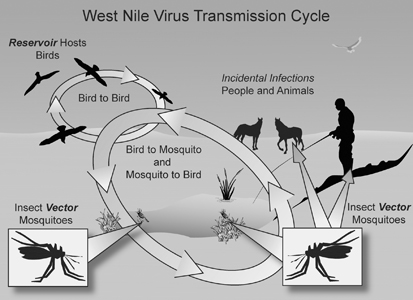
Global warming will only get worse if we continue to add greenhouse gases to the atmosphere. To get an idea of some of the possible problems we will encounter we will look at some examples. Infectious diseases like it hot. Due to global warming more people worldwide will suffer from infectious diseases such as salmonella poisoning and cholera (Cimons, 2015). Also, malaria and the West Nile virus, illustrated in Fig. 6.10, are expected to worsen where mosquito breeding is enhanced due to warmer weather. These deceases are likely to expand beyond the regions where they are now prevalent.
Animal and Plant Life will Suffer
|
Fig. 6.2. Polar bears on Sea Ice. (USGCRP) |

In addition to the impact on humans, animal and plant life will be greatly affected by global warming as the Earth gets warmer and warmer. In Fig. 6.2 above the polar bears are being seriously challenged as more and more sea ice is disappearing (Reuters, December 2015) during summer months and into the fall. That makes finding food for them very difficult, as they use the sea ice to get to seals, their preferred diet. In many areas in the Arctic polar bears are having to swim farther and farther to find a pieces of sea ice big enough to support them. The International Union for Conservation of Nature (IUCN) concluded that the continued warming of the Earth will threaten the survival of polar bears. By mid-century they think there is a high probability that the polar bear population will be reduced by more than 30 percent. But similar challenges will exist for many birds, amphibians, reptiles, insects, and other creatures, as many of them can only tolerate a limited range of temperature and moisture. Plant life is also vulnerable for the same reasons.
Droughts and Urban Heat Islands
|
|
||
Fig. 6.3. Dry lake. (USGCRP) |
Fig. 6.4. City smog (haze). (USGCRP) |
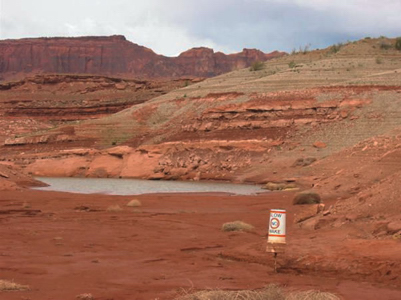

Global warming causes extremes in weather. Areas that are now dry are expected to become larger and get dryer. This will affect many people in the world. The problem areas in places like Africa will get worse. In the United States the Southwest is especially vulnerable. Many cities already have reduced water supplies because their sources of water, like the lake in Fig. 6.3, are drying up. Unless alternative sources of water are found for homes and irrigation for crops drought stricken areas will seriously challenge people and could cease to be livable. The city scene in Fig. 6.4 will become more common leading to more heat related deaths and more diseases due to the poor quality of the air we breathe.
Storms
|
|
||
Fig. 6.5. Intense storm. (USGCRP) |
Fig. 6.6. Large ocean waves. (USGCRP) |
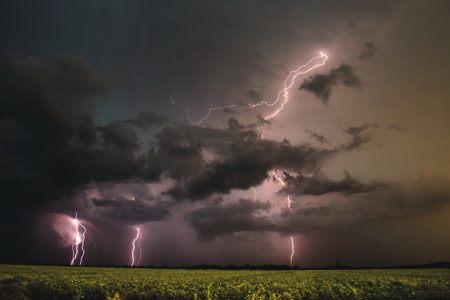

Storms, like the one pictured in Fig. 6.5, are predicted to be more intense. Remember that storms are predicted by weather. From climate theory we know that global warming makes storms more intense. Areas that are now wet will get larger with increased amounts of precipitation. This is very easy to understand. As the Earth warms there is greater evaporation from the warmer bodies of water. At the same time as the air gets warmer it can hold more water vapor, meaning greater amounts of rain, snow, sleet, or hail.
The prediction for hurricanes is interesting. More intense hurricanes are expected because of the warmer ocean water. But it is also expected that there will be winds at the higher elevations that will prevent some hurricanes from forming. So it is thought that the lower category hurricanes will be less likely to occur. In the future when hurricanes occur, as determined by weather conditions, we can expect a larger number of the higher category hurricanes. These intense storms will produce large ocean waves as seen in Fig. 6.6. Large storm surges are more likely and because of rising sea level will ride higher and flood even further inland than is possible now. The ocean waves ride on top of the water, and therefore the wave crests will add even more to the height of the water reaching even further inland.
|
Fig. 6.7. Hurricane damage due to Katrina and Rita. (USGCRP) |
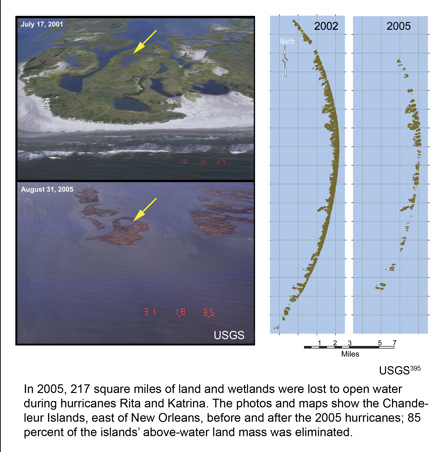
Hurricane damage like that illustrated in Fig. 6.7 due to Hurricanes Katrina a Rita is likely to become more common. The before and after pictures are stunning. They show what the offshore regions near New Orleans looked like before and after Hurricanes Katrina and Rita struck in 2005. Both storms became Category 5 hurricanes in the Gulf of Mexico.
Sea Level Rise
|
Fig. 6.8. Predicted coastal flooding. (USGCRP) |
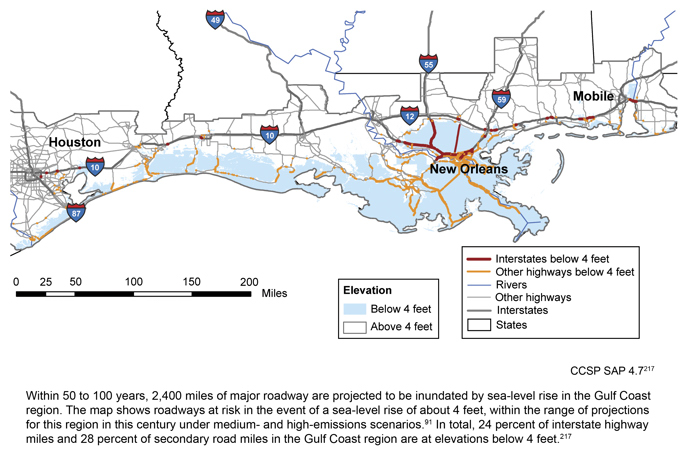
As sea level rises more and more regions will not be livable or usable. Fig. 6.8 shows what could happen on the Gulf Coast near New Orleans if the sea level rises 4 feet (1.2 meters). Based on a medium emission level or greater this is thought very likely to happen within the next 50 to 100 years. Not only will people on the coast be displaced, some roads and highways along the coast will be underwater.
There are major delta systems (Mooney, August 2015) throughout the world such as the Mississippi delta. They are important places for people to live and offer benefits such as locations for shipping and fishing. As sea level rises the deltas are more and more vulnerable to storms and flooding.
A study was done (Strauss, et al, 2012) of how much land would be lost in the contiguous lower forty-eight states in the United States when sea level rises 3.28 feet (1 meter). When you add this vertical distance to the current high tide line along a coast it is found that a large amount of what is now dry land or land covered with fresh water will be flooded by sea water. Of the lower 48 states the states with the most population impacted in decreasing order are Florida, Louisiana, California, New York, and New Jersey. The estimated population affected in Number 1 Florida exceeds 1.5 million people. Number 2 Louisiana has nearly one million people affected by the rise in sea level. When considering the total loss in land, which includes both dry land and land now covered by fresh water, the states that are most impacted in decreasing order are Louisiana, Florida, North Carolina, California, and South Carolina. Number 1 Louisiana is expected to lose 5,215 square miles (13,510 square kilometers) to the rising sea. Considering dry land only Louisiana is still ranked Number 1 losing 1,180 square miles (3,058 square kilometers). The flooding will be even worse when a storm surge occurs and when there are ocean waves, because they will be riding at the higher sea level and reach land further inland.
In another study (Strauss and Ziemlinski, 2012) the number of energy facilities that now rest on land that will go under water with a rising sea level were determined. For a sea level rise of 3 feet (0.9 meters) over the current high tide line they found Louisiana had the vast majority of energy facilities in the lower forty-eight states that would be impacted. The number for Louisiana is 131. Both California and Florida tie for second place with 19 each. An energy facility includes oil and gas, natural gas, electric facilities, and other facilities. Of the 131 energy facilities in Louisiana 110 are natural gas facilities.
These problems will occur throughout much of the world in coastal regions. Some islands will no longer be inhabitable. It has been estimated that with a 1 meter (3.28 feet) rise in sea level that 60 million people throughout the world will have to be relocated. Further, many more people will be more vulnerable to flooding from storm surges due to hurricanes and other storms (Gavin Schmidt in Schmidt and Wolfe, 2009). These predictions seem even more likely based on recent data that show that not only the Greenland ice sheets but also the Antarctic ice sheets are braking up and melting faster than had been expected. Costal cities throughout the world will be vulnerable. The financial cost to individuals, companies, and world governments will be enormous.
The Melting of Ice Sheets
The ocean conveyor belt that circulates water around the planet appears to be slowing down due to an enormous quantity of cold meltwater from the Greenland ice sheet (Lamont-Doherty Earth Observatory Staff of Columbia University, April 2016). Cold fresh meltwater flows as rivers across the ice sheet into fjords and continues into the ocean. On the east coast a large percentage of the meltwater is taken by the East Greenland Current to the Labrador Sea. The cold fresh water is to light to sink and there is evidence that this is upsetting the global circulation causing a slow down of the ocean conveyer belt.
Based on other research (Upton, March 2015; Kahn, July 2015) the circulation may have slowed down to levels not experienced in the last thousand years. The analysis is based on combining temperature data with climate data determined from ice cores, coral samples, and tree rings. With even more melting expected this could further affect global circulation including the Gulf Stream making it colder for cities warmed by it in North America and Europe. It can also affect sea levels and cause a loss in deep ocean nutrients needed for fisheries and food chains that are found in shallow Atlantic waters.
In October 2011 NASA scientists discovered a major ice crack in the Pine Island Glacier which drains the West Antarctic Ice Sheet. The crack is clearly seen in an image taken in November 2011 from a spacecraft and shown in Fig. 6.9. The crack was found to be 260 feet (80 meters) wide and 195 feet (60 meters) deep. The crack was expected to eventually extend all the way across the glacier and calve a very large iceberg with an area of about 350 square miles (900 square kilometers). In July 2013 the crack extended all the way across the glacier and it calved an iceberg one-fourth the size of the state of Rhode Island causing sea level to rise (NASA 2013). Note that it is not necessary for the icebergs in the ocean to melt in order for sea level to rise. They only have to move from land to water. This is because as the ice floats it sinks into the water by an amount that displaces its own mass, raising sea level. You see this happen every time you add an ice cube to a glass of water. The same thing is happening with the Greenland ice sheet where both small and large icebergs are calved. Since icebergs end up in shipping lanes ships have to be constantly on the lookout for them to keep from being sunk by them.
|
Fig. 6.9. Pine Island Glacier of the West Antarctic Ice Sheet. (NASA/GSFC/METI/ERSDAC/JAROS & U.S./Japan ASTER Science Team) |
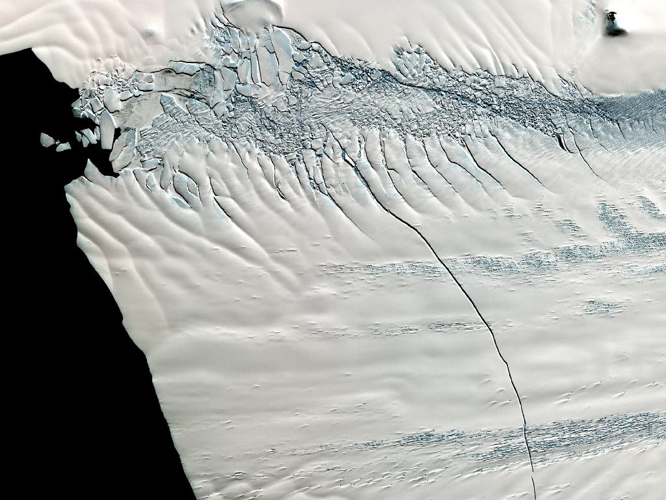
Sea level is now expected to rise faster than had been expected only a few years ago. The breakup of large ice sheets is of concern. Once an iceberg is calved the ice that was behind it can move forward with more and more icebergs being calved. It is possible that a tipping point could eventually be reached where the disintegration of an ice sheet cannot be stopped. That is a frightening possibility as coastal cities on our planet could be submerged under water.
Considering the previous ice ages (glacial periods) the warm periods between them (interglacial periods) have not been long enough and warm enough to melt much of the planet ice. But global warming is changing things. If all of the ice on Earth were to disintegrate or melt and end up in the oceans, sea level would rise by about 250 feet (77 meters) (Hansen, 2009.) Most of the planet ice is in Antarctica, and it might take centuries for all of it to melt or breakup, depending on the degree of global warming, how the ice sheets disintegrate, and how soon another ice age occurs. But only a fraction of the ice has to melt or breakup to cause very serious damage to many costal cities. The only way to stop the rise in sea level is to mitigate the warming of the Earth. But this could take a long time, many decades or longer once we tackle the problem.
Climate and Past Civilizations
|
Fig. 6.11. Temple at Chichen Itza. (Breeding) |
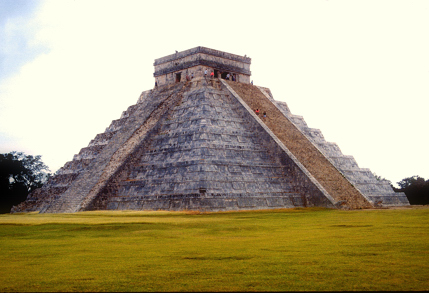
Fig. 6.11 shows a picture of the main temple at Chichen Itza in Yucatan, Mexico. This is a Mayan Ruin site. I took the picture on a visit there. When you climb the 91 steps to the top you are 82 feet (25 meters) high, and can look out over what was once a thriving city. It and neighboring cities were abandoned in the 1300s. It is now known that climate was one of the main reasons due to an intense drought. A number of other cities were abandoned in the past, and it is known that climate was a factor for some. This includes Angkor in Cambodia.
The Problem
It should be clear that we have very serious problems due to global warming. Based on data climate is changing faster now than at any time in recorded history (Perkins, 2014). For example, in recent years we are experiencing average annual temperatures that are the warmest since records have been kept. On the whole mountain glaciers are now losing more ice than they have gained. Global sea level is at a record high and is now rising at a rate of about one-eight of an inch (3 millimeters) per year. And the concentration of carbon dioxide in the atmosphere is now about 403 ppm, which is unusually high. Going back 800,000 years it was not until the early 1900s that the value was higher than 300 ppm. Considering the poles the arctic sea ice is melting at rates not seen before. The coverage area shrinks to its smallest amount in September, and the yearly trend now is to more open water and less sea ice. At the South Pole the average temperature is also rising. In 2013 the average annual temperature was -53.3 degrees Fahrenheit (-47.4 degrees Centigrade), which was a record high since record keeping began in 1957.
If global warming continues unabated there will most certainly be more intense droughts causing devastation on a much greater scale than happened at Chichen Itza or Angkor in previous times, or as seen in Sahel today. Increased flooding due to heavy rains is also a problem. Iowa has already had three 100-year floods in 20 years, and there are other examples. Intense storms including hurricanes and storm surges will add to the problems of mankind and they all will be very expensive to fix.
It should be obvious that we must take adequate measures to reduce the greenhouse gas emissions in the atmosphere. We need to examine what we can do to protect and save life on our planet. That is what we will look at next.
Pages
Page 1: Climate Change and Definition
Page 2: Evidence of Global Warming
Page
3: Measurements
Page 4: Ice Ages
Page 5: Causes of Climate Change
Page 6: Predicting the Future
Page 7: How Can We Fix Our Climate?
Page 8: References
*A slide show version of these pages on climate change is available for presentations to groups. See References for more details.
Copyright 2011- 1015; For questions or comments contact the webmaster.