How Can We Fix Our Climate?*
by
J. Ernest "Sunny" Breeding, Jr., PhD Geophysics
Reducing Greenhouse Gases
|
Fig. 7.1. Global average surface temperature averaged by decades. (Climate Central) |

Figure 7.1 (Freedman, 2013) displays the decadal average of the global average surface temperatures. The dramatic increase in temperature over the last three decades is alarming. There is currently no reason to think that this rapid increase in the global average surface temperature will slow down anytime soon. The increase is driven by greenhouse gases, which obviously need to be reduced.
Pollution by Country
|
Fig. 7.2. Greenhouse Emissions by Country. (EPA) |

Figure 7.2 shows the greenhouse gas emissions for the world's major polluters. In recent years China has replaced the United States as the the number one polluter of the atmosphere on an annual basis. They have added a lot of coal fired power plants, and they now have terrible smog problems. There are also a lot of coal fired power plants in Europe. We really need to move away from fossil fuels. To do so will take planning and time and must involve electricity, transportation, and other sources of greenhouse gases. This is a worldwide problem and it will require a major effort with many changes.
U.S. Greenhouse Gases
|
Fig. 7.3. U.S. Breakdown of greenhouse gases. (EPA) |

In a breakdown of greenhouse gases in the United States it is seen in Fig. 7.3 that carbon dioxide is 82% of the total. However, methane is a much worse greenhouse gas and it is increasing. A lot of it can be released as glaciers melt and permafrost thaws. There is also an enormous supply of methane on continental shelves in the seas and oceans.
U.S. Sources of Greenhouse Gases
|
Fig. 7.4. U.S. Sources of greenhouse gases. (EPA) |
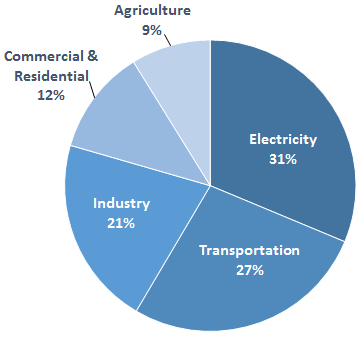
Where do most of the greenhouse gases in the United States come from? A look at Fig. 7.4 is quite revealing. Fifty-eight percent of the greenhouse gases in the United States come from electricity and transportation. Clearly these are the areas we need to concentrate on in order to reduce greenhouse gases.
U.S. Electricity by Source
|
Fig. 7.5. U.S. Electricity Production in 2010. (EPA) |
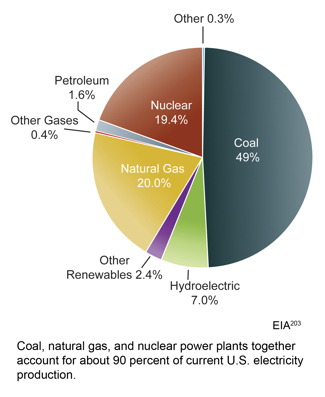
Fig. 7.5 shows the breakdown of energy sources used in generating electricity in the United States. in the year 2010. More than 70% of the electricity in the United States was generated using fossil fuels. Coal was used in nearly one half of the production of electricity. In the last few years the numbers in the pie chart for coal, natural gas, and renewables have changed. Muyskens, Keating, and Granados (July, 2015) determined the breakdown of the generation of electricity by source in the United States in 2015. The results in the following table show, respectively, the Type of plant, Number, and Percentage of U.S. electricity generated:
Coal, 511, 34
Natural Gas, 1740, 30
Nuclear, 63 (99 reactors), 20
Hydro, 1436, 7
Wind, 843, 5
Solar, 772,1
Oil, 1098, 1
Compared with 2010 the production of electricity using fossil fuels has decreased by about 6 percent. There has also been a shift from coal to natural gas for some power plants because gas has become more plentiful and less expensive than coal. In the five years the use of coal had decreased by 15 percent and the use of natural gas has increased 10 percent. At the same time the use of renewables has increased by about 4 percent.
With so much electricity generated using fossil fuels another way to reduce carbon emissions is to use energy more efficiently. That means everything from more fuel-efficient vehicles to more fuel-efficient power plants (Sakelaris, 2014). Higher efficiency results in less consumption.
Fossil fuel Power Plants
|
Fig. 7.6. Smoke stack of a coal fired power plant. |

One smoke stack from a coal fired power plant can add lots of greenhouse gases to the air, as seen in Fig. 7.6. Clearly, if we choose to continue using fossil fuel power plants the greenhouse gases need to be removed at the power plant so that they do not go into the atmosphere. Coal-fired power plants produce a greater amount of carbon dioxide than any other type of power plant.
April is the month when the least amount of carbon dioxide is emitted by power plants because that is when there is the least demand for heating and cooling. Power plants in the United States emitted less carbon dioxide in April 2015 than at anytime since April 1988, a 27-year low (Borenstein, 2015; Magill, August 2015). There are a variety of reasons given for this happening. The main one is the switch from coal to natural gas at many plants. Gas produces about one-half as much carbon dioxide as does coal. The greater use of renewal energy sources like solar and wind is also important because these sources are nonpolluting. Greater efficiency is also a factor since it reduces the amount of energy needed. Another factor for fossil fuel plants can be warmer winters, and therefore less energy needed to heat homes and businesses (Magill, 2013).
We need to see a further shift away from fossil fuels. But there have been charges that we need more jobs in the fossil fuel industry to help our economy. Coal produces the most pollution. So what is the truth about jobs in the energy sectors? The following data on jobs (Nesbit, 2014) was the best available for the study that was published in June 2014. A century ago there were 700,000 jobs in the coal industry. That number has dropped to 89,000 with nearly half of them in two states: Kentucky and West Virginia. How does this number compare with other sectors of the energy industry as a whole? Note the following table:
Coal 89,000
Solar 143,000
Wind 85,000
Nuclear 120,000
Geothermal 13,000
Considering the latter four types of energy they are responsible for about 361,000 jobs, and the total is rapidly increasing without adding greenhouse gases to the atmosphere. By comparison both the future of jobs and a positive impact on the economy are clearly in the nonpolluting energy sectors.
Nuclear Power
|
Fig. 7.7. Nuclear power plant. (Wikipedia) |

Fig. 7.7 is a picture of a nuclear power plant. Nuclear power plants generate electricity on a large scale without producing greenhouse gases. Nuclear power is the only power source that competes with fossil fuels for generating equivalent amounts of electricity. Currently the United States has the most nuclear power plants of any country, followed by France, Japan, Russia, and China (Magill, January 2015). The Intergovernmental Panel on Climate Change (IPCC) has concluded that we have to cap carbon dioxide emissions at 450 parts per million (ppm) in order to prevent a rise in the global average surface temperature of 3.6 degrees Fahrenheit (2 degrees Centigrade) from the value at the time of the Industrial Revolution. In order to do this it is likely that the world will have to replace a lot of coal fired power plants by nuclear power. As of 2015 China generates only 2 percent of its electricity with nuclear power. But they are leading the world in nuclear power expansion with 29 reactors under construction. In the United States most nuclear reactors are more than 30 years old. Only five new ones are under construction, and since 2013 five nuclear reactors have been taken offline. France generates about 85% of its electricity by nuclear power. We could reduce our greenhouse gas emissions considerably if we generated such a high percentage of electricity by nuclear power.
Wind Power
|
Fig. 7.8. Wind power. (USGCRP) |

Wind power does not have the potential to generate electricity on the scale of a nuclear power plant. However, their use, as in Fig. 7.8, should be encouraged since wind power can make a significant contribution and does not create greenhouse gases. As of 2015 three states (Mooney, 2015) generate more than 20 percent of their electricity from wind power: Iowa, South Dakota, and Kansas. Iowa produces the highest percentage of electricity from wind power (Iowa Wind Energy Association staff, 2015). By the end of 2014 Iowa was generating 28.5 percent of its electricity from wind turbines. With additional capacity being added Iowa expects to generate more than 30 percent of its electricity by wind by the end of 2015. By 2020 it has the potential to generate 40 percent of its electricity from wind (Eller, Donnelle, 2015). Iowa also exports energy from wind to other states. Other states have plans to develop wind farms including offshore in the ocean. Wind turbines are also seen in Europe.
Despite some claims to the contrary, wind turbines are not the worst killers of birds, and its not even close (Randall, 2014). By far the worst killers of birds are buildings and windows, followed by high tension lines, cats, vehicles, pesticides, communication towers, and then wind turbines. To put this in perspective, wind turbines kill only 1 percent as many birds as the next least killer, communication towers.
Solar Power
|
Fig. 7.9. Solar Power. |

Solar power has great potential when there is lots of sunshine, but is also useful on cloudy days. Homeowners and businesses can put solar panels on their roofs to heat water or generate electricity. See the examples in Fig. 7.9. It reduces the cost of electric bills from power companies. More and more businesses and home owners are choosing to use solar panels as their prices have become more affordable through advances in technology. Solar panels are already widely used in some countries in Europe. Solar is primed for enormous growth when adequate storage capacity is added to it (Nesbit, 2014). That is expected to happen within the next decade. It is difficult to know how many solar panels have been installed on homes and businesses since those kinds of numbers do not seem to be available. The use of solar panels in place of power plants burning fossil fuels further reduces greenhouse gases into the atmosphere.
|
Fig. 7.10. Energy efficient light bulbs. |

One thing that people can do immediately is to get rid of the old fashioned incandescent light bulbs. That is the message in Fig. 7.10. The old fashion incandescent light bulbs (McKenna, 2015) are very inefficient. Consider a 60-watt incandescent bulb. A 14-watt compact fluorescent (CFL) bulb, pictured on the left in the above picture, produces the same amount of light and so does a 6-watt light emitting diode (LED) bulb. An LED light bulb uses only 10 percent of the energy used by an incandescent light bulb. Replacing incandescent bulbs by more efficient bulbs cuts down on the consumption of energy, which is a very good thing. They are also more cost effective in the long run. Cities and organizations are taking advantage of the savings. Over the next several years Iowa City, Iowa is changing all of their street and other city lights to LED bulbs (American Infrastructure staff, 2015). The change is expected to save the city $100,000 per year in energy costs.
Transportation
|
Fig. 7.11. High speed electric powered trains. (Wikipedia) |

As we saw above a lot of greenhouse gas emissions result from transportation. In this regard countries in Europe and Japan are way ahead of the United States. The high speed train in Figure 7.11 is not only very fast but runs on electricity. This train is in service in Great Britain. These high speed electric trains reach speeds greater than 200 miles per hour. When an electric train is powered by nuclear power or other nonpoluting energy sources there are no greenhouse gas emissions. High speed electric trains should be the preferred way to travel between New Orleans and Houston or Atlanta. You could go from city center to city center. Other obvious choices are between Washington, D.C. and New York City and Boston. Consider Los Angeles to San Francisco. There are many other examples. This could cut down significantly on pollution if such trains were used instead of automobiles or planes where possible, and in place of trucks to move goods. There is no easy way to make a jet aircraft nonpolluting. But they are working to make planes more fuel efficient as well as automobiles.
Sequestration
|
Fig. 7.12. Sequestration of greenhouse gasses. (USDOE) |

The storage of greenhouse gases is called sequestration. There is natural sequestration, as is illustrated in Fig. 7.12. as terrestrial sequestration. A recent satellite survey finds that there are more than 3 trillion trees on our planet (Pennisi, 2015). But of that number we are losing 15 billion trees a year to timber, farmland, toilet paper, and other uses. The trees absorb and store a lot of carbon dioxide, something we can be very grateful for. We need more trees not less. The deserts are where we find the least number of trees, whereas the Arctic boreal forests contain the densest areas of tree coverage. The arctic has 24 percent of the planet’s trees. The tropics and subtropics have the most with 43 percent of the total number of trees.
It is very unlikely that we can reduce greenhouse gas emissions enough and at a fast enough rate to completely solve our problem of global warming. As a result, we will have to clean the atmosphere of greenhouse gases. This is done by geological sequestration as shown in Fig. 7.12. Carbon dioxide is taken out of the air and converted to a benign form and than placed in a geological formation under ground. Research is ongoing to find the best ways to do this. A very interesting video on Carbon Sequestration Research is presented by the Lamont-Doherty Earth Observatory.
There is ongoing research (Magill, July 2015) to determine if it is feasible to capture carbon dioxide from fossil fuel power plants and oil refineries and then store the emissions in rock formations deep underground. The collected carbon dioxide is compressed and then transported and injected into an airtight rock formation. Possible storage areas are beneath the floor of the Gulf of Mexico where there has been extensive oil drilling and where there are existing oil and gas pipelines
Canada has the first large-scale coal-fired power plant in use with carbon capture and storage technology (Goldenberg, 2014). The Boundary Dam power plant is in Saskatchewan. The captured carbon dioxide is pumped into the ground and sold to an oil company for priming nearby oil fields or into geological formations. It would be better if all of the carbon dioxide was sequestered. In Kempler, Mississippi they are constructing a large-scale power plant that is designed to convert coal into gas, capture a high percentage of the carbon dioxide, convert the carbon dioxide into a liquid, and then pump it underground into nearby oil fields (Drajem, 2014). Left over in the process is mostly hydrogen and nitrogen, which are sent to a turbine and burned to generate electricity. The plant is scheduled to be operational in 2016.
How Can Individuals and Cities Reduce Greenhouse Gases
Homeowners and cities can reduce greenhouse gas emissions a number of ways which include (Valentine, September 2015): Making buildings more energy efficient by choosing light-colored roofs, installing solar panels, adding insulation, installing double pane windows, switching to CFL or LED lighting, and using energy saving appliances. Cities can also increase public transit and capture methane from landfills. Making these improvements can also result in expenses being reduced.
Preparing for the Future
Some cities, states, and world governments are already making plans to deal with a warmer Earth. For example, Chicago is taking a look at their sewer pipes and flood-control reservoirs, which are not capable of handling the flooding from the more intense rains that are expected in coming years. They have already repaved more than one hundred alleys with porous pavers or pervious concrete so that rainwater can seep into the ground rather than flow into sewers and possibly backup into businesses and homes.
With sea level rising ocean waves and storm surges will ride at higher levels and penetrate further inland. This is not good news, especially since more intense storms including high category hurricanes are expected in the future due to a warming Earth. Some governments are making plans for this eventuality. More serious droughts like that currently seen in the southwestern United States are expected in the years ahead. This will lead to dwindling water supplies and a loss of more homes due to area-wide fires caused by dry conditions. More intense tornados are also expected in future years. All of these problems will lead to loss of life and enormous amounts of damage with big expenses for individuals, insurance companies, and all governments including agencies like FEMA in the United States. Can we afford a warmer Earth?
What is a Reasonable Concentration of Carbon Dioxide?
|
Fig. 7.13. Concentration of atmospheric carbon dioxide at present compared with values during the last ice ages. (Scripps Institution of Oceanography) |

The preindustrial level of carbon dioxide in the atmosphere was about 280 parts per million (ppm). The trend level value for March 2016 is about 403.2 ppm, and in Fig. 7.13 that value is compared with values during the last ice ages (Freedman, 2013). It is seen that our present value of the concentration of carbon dioxide in the atmosphere is significantly higher than at anytime in at least the last 800,000 years. Clearly the present value is too high and unusual compared with values that occurred during the recent ice ages. This is why the rates at which ice sheets are melting or breaking up are increasing and sea level is rising at an accerated rate. Glaciers are also decreasing in size at an increasing rate. There is also no question that a lot of plant and animal life are being stressed by global warming. In addition, there is the worry about reaching tipping points where we would lose control of our planet. So it stands to reason that the recent trend level value of 403.2 ppm needs to be reduced.
It is important to determine what a reasonable, i.e., a safe level of carbon dioxide would be. A serious study was conducted by James Hansen and his group. Hansen was director of the NASA Goddard Institute for Space Studies, which is affiliated with Columbia University and is located at the main campus of the university. Hansen is also an adjunct professor at Columbia University and posts updates on climate change on a web site (See References). He recommends that we restore Earth's energy balance so that as much energy is radiated to space as is absorbed from the sun. That would keep the Earth from getting any warmer. Hansen (2009) came to the conclusion that the atmospheric value of carbon dioxide should be 350 ppm or less. Getting back to this value will be difficult and take time. We will have to reduce emissions of carbon dioxide and we well very likely need to clean the atmosphere through geological sequestration. Once the energy balance is stabilized climate scientists can reevaluate the data to see if a different concentration level of carbon dioxide is preferred.
In 2009 the Intergovernmental Panel on Climate Change (IPCC) concluded that in order to mitigate climate change and prevent serious damage to the Earth it is necessary to prevent the global average surface temperature from increasing more than 3.6 degrees Fahrenheit (2 degrees Centigrade) beyond the temperature at the time of the Industrial Revolution in about 1760 (Thompson, April 2014). At a meeting of the IPCC in 2014 they concluded that in order for that to be achieved the greenhouse gas emissions will have to be 40 to 70 percent lower than the 2010 value by 2050. Further, by the end of the century the emissions will have to be zero, or could require taking carbon dioxide out of the atmosphere.
It should be noted that we only want to reduce but not remove all carbon dioxide and other greenhouse gases that absorb infrared radiation in the atmosphere. If there were no atmosphere it is estimated that the global average surface temperature of the Earth would be about -0.4 degrees Fahrenheit (-18 degrees Centigrade). This is cold, and days would be very hot and nights very cold. By comparison, the present value is about 59 degrees Fahrenheit (15 degrees Centigrade). The greenhouse effect makes a big difference, and adds immensely to our quality of life on our planet (Hensen, 2008).
Another Ice Age?
Another ice age would destroy many things including cities at the higher latitudes where expanding ice sheets would destroy them. Away from the ice sheets the climate would be much different than what we experience now. It would become brutally cold in a lot of places. Fortunately this can be prevented. Since man can produce global warming it would also be possible to add just the right amount of carbon dioxide to the atmosphere to warm the Earth. The objective would be to counter the cold resulting from movements of the Earth in its orbit about the sun. But first we have to deal with the problem of global warming and stabilize our planet.
Climategate
Global warming crosses many disciplines in science, so it is not surprising if people find the subject complicated and confusing. But a major problem is confusion purposely created by people that do not want to see global warming accepted by the public. This follows because in order to reduce greenhouse gases we have to make changes in the way we generate energy, deal with transportation, and other things that affect the way we live. Although many companies and people will prosper from these changes, others will not. Coal companies, for example, stand to lose as we convert to nuclear energy and other renewables. Many of the companies that stand to lose have mounted an enormous effort to maintain the status quo. There are many high paid lobbyists in Washington, D.C. with this very objective.
A good example of the creation of confusion is the so called "climategate." Some nonscientists used stolen email to raise doubts about the research done by scientists at the University of East Anglia in southeast England. That is also a prominent data center and the nonscientists were wanting to get access to the data. But the scientists decided that they did not want to share the data with these antagonists. That was a mistake. The antagonists were able to raise doubts in the public about the calculations at East Anglia that showed the Earth was experiencing global warming. The result was that they convinced a lot of the public that global warming is a hoax.
Unfortunately many people in the news media do not understand global warming and they gave the story a lot of publicity without properly researching the subject. Had they done so they would have discovered that climate science is not dependent upon the research at East Anglia or with any other group as there are multiple research centers worldwide. The fact is there are two prominent climate data centers located in the United States. One is at the NASA Goddard Institute for Space Studies referred to above, and their data is available to the public (Hansen, 2011.) Another important data center is run by NOAA. All three data centers work independently, but a comparison of the different results are quite consistent (Henson, 2008.) Calculations are also done at many universities and laboratories. The different research centers share and compare results and ideas, which creates a system of checks and balances. The Associated Press (2009) deserves credit for assigning five reporters to look into the story at East Anglia. They reported: "E-mails stolen from climate scientists show they stonewalled skeptics and discussed hiding data - but the messages don't support claims that the science of global warming was faked, according to an exhaustive review by The Associated Press."
The Climategate controversy has been described with great detail in a book by Michael Mann (2012). Dr. Mann was at the center of this fight, and he explains how statements in stolen email he and his colleagues exchanged were taken out of context and distorted. He also discusses the inquisition that he and his colleagues were subjected to by some members of the U.S. Congress. Further, he clearly explains the methods used by the climate change deniers in their attempt to discredit not only climate science but climate scientists. Dr. Mann, some of his colleagues, and their families were also subjected to some very scary threats. What happened here is awful by any decent standards. Unfortunately, it will likely continue.
Global warming is a major story, and why many newspapers and other news media have not picked up on it in feature articles and stories is surprising. There are many climate scientists available to explain the science and what the latest measurements show. It is certainly best to learn from the experts. Fortunately, there have been a number of very good books published on climate change in the last few years, and a number of them are listed in the References (Page 8.)
|
Fig. 7.10. The Earth. (USGCRP) |

Our Future
It is interesting to consider what would happen to the Earth, seen in Fig. 7.10, if we allow greenhouse gases to be added to the atmosphere at ever increasing rates. Eventually we would pass tipping points and in time the planet would not be habitable. Humans would join the list of species that have gone extinct. Already 99.9% of all species that have inhabited the Earth are extinct. But in time the Earth moving in its orbit about the sun would experience another ice age, and the atmosphere would finally be cleaned of the human created greenhouse gases. Eventually other forms of life would flourish. Our problem is that the natural processes cannot clean the atmosphere fast enough to fix the planet for us. The problem is left up to us.
People throughout the world will have to work together to reduce greenhouse gases in the atmosphere. This should be soon, because the longer we wait to fix our problem the harder and more expensive it will be to fix. It should be obvious that the long term future of mankind, and indeed all animal and plant life, depends upon whether we get human created greenhouse gases reduced and controlled at some acceptable level. In the short term, it will have a major impact upon our children, grandchildren, and their children by mitigating the worsening conditions of a warming Earth.
There is good news. There is no mystery about what we need to do to fix the Earth. It would be much worse if we did not know what to do!
Scientific Consensus on Global Warming
A number of scientific organizations have released official statements on climate change. There is widespread consensus that our planet is being warmed by greenhouse gases produced by man in the burning of fossil fuels, and the problem is viewed as very serious. The statements of a number of respected scientific organizations are found in the links below:
American Association for the Advancement of Science
American Chemical Society
American Geophysical Union
American Meteorological Society
American Statistical Society
Letter on Climate Change signed by 18 Scientific Societies to the U.S. Senate
Letter on Climate Change signed by members of the U.S. National Academy of Sciences
The references and contact information are found next.
Pages
Page 1: Climate Change and Definition
Page 2: Evidence of Global Warming
Page
3: Measurements
Page 4: Ice Ages
Page 5: Causes of Climate Change
Page 6: Predicting the Future
Page 7: How Can We Fix Our Climate?
Page 8: References
*A slide show version of these pages on climate change is available for presentations to groups. See References for more details.
Copyright 2011-2015; For questions or comments contact the webmaster.